Sport & Recreation New Initiative Follow-Up Report
This follow-up report must be submitted within 90 days of the completion of your initiative to receive the remaining funding.
Protection of Privacy
forward it to: City of Regina Access & Privacy Team Office of the City Clerk PO Box 1790 2476
Victoria Avenue Regina, SK S4P 3C8 Email: lafoip@regina.ca Phone:
307-777-7262 Fax: 306-777-6809
Privacy Complaints
Access to Information Office of the City Clerk
Regina.ca Privacy
Transit Class Trips Terms of Service
View our terms of service for booking a class trip with Regina Transit.
2021 Special Event Major Follow-Up Report
To receive the remaining grant funding, this follow-up report must be submitted within 90 days of your special event.
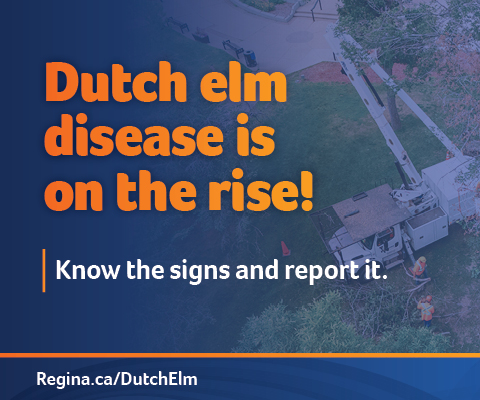
Dutch Elm Disease
hed instead of falling to the ground. This is the most obvious sign of Dutch elm disease. Call
Service Regina at 306-777-7000 or report it online at Regina.ca.
Learn more at Regina.ca/DutchElm Help stop the spread. Watch for
"flagging" branches. Even as firewood, don’t transport or use elm wood. Look for an alternating red
and cream “wafer” pattern in the cross-section of the bark. Know the signs of Dutch elm disease and
help protect our trees. Look for the following: Oval leaves with pointed, serrated edges. Small,
papery, disk-shaped seeds, when present. Light to dark grey bark with deep grooves. Is it elm wood?
Don’t store or transport elm wood. Don’t use elm wood as firewood. Don’t prune elm trees between
April 1 and August 31. Is it an elm tree? Dutch Elm Disease Control Program The City of Regina
implemented a Dutch elm disease control program to reduce the spread of Dutch elm disease and limit
the number of local trees lost. Step 1 – Monitoring and Surveillance City workers systematically
inspect all City-owned and private trees once every two weeks for wilting or yellow leaves on one
or more branches of a tree. If a tree looks suspect, staff take samples and submit them for
laboratory culturing to see if the tree has the DED fungus. Step 2 - Elm Bark Beetle Monitoring Elm
Bark Beetles can carry the Dutch elm disease fungus as they move from tree to tree, so we monitor
beetle numbers throughout the city. To accomplish this we use pheromone traps. We have 86 traps to
attract and capture three species of elm bark beetles (European, native and banded). The US Forest
Service provides great photos and explanations of Elm Bark Beetles. Step 3 - Pruning and Sanitation
The City immediately cuts down and buries all infected wood from elm trees at the landfill. ...
Resident Verification Program and Non-Resident Recreation Fees
disability that prevents you from completing in‑person verification, please contact the Inclusion
Support Office at 639-590-8895 or inclusionsupport@regina.ca for
assistance with the resident verification process. To confirm your status, call 306-777-PLAY (7529)
or visit a recreation facility. Expand this section to read our frequently asked questions and
answers. When did resident verification start? Resident verification began February 1, 2026 and the
non-resident fee is now in effect for all registered recreation programs. Does this apply to all
registered recreation programs? Yes, all registered recreation programs are subject to the
non-resident surcharge if residency is not verified. How often do I need to verify? Verification
only needs to be completed once, unless your address changes. Can I verify my residency online? No,
verification must be done in person. Who can verify residency for a family account? Any adult
listed on the account can verify residency for the entire family. When does the non-resident
surcharge begin? The non-resident surcharge begins with Summer 2026 registered programs. How much
is the non-resident surcharge? The non-resident surcharge is a 50 per cent increase on registered
program fees. Does the surcharge apply to Leisure Passes? No, the surcharge applies only to
registered programs such as swimming lessons, fitness programs and fine arts. It does not apply to
single admissions, bulk admissions or Leisure Passes. I changed my address online, do I need to
re-verify? Yes. If you change your address online, your account will automatically revert to
non-resident status and you will need to re-verify at a leisure centre. What happens if I don’t
verify my residency? If you do not verify, you will be marked as a non-resident, and as such you
will have a later registration date and be subject to a 50 per cent surcharge. If I forget to
verify and register as a non-resident, can I get a refund? No, refunds will not be offered. Please e
nsure that you have verified your address before registering for a recreation program. What if I
have a disability that prevents me from completing in-person verification? If you have a disability
that prevents you from completing in‑person verification, please contact the Inclusion Support
Office at 639-590-8895 or InclusionSupport@regina.ca for assistance
with completing the resident verification process. How can I tell if my address has been verified?
You can confirm your residency status in the following ways: Call the PlayLine at 306-777-PLAY and
have an agent check your account status. Log into your Recreation Online account. When you add an
activity to your cart: If your address is verified, only the standard program fee will appear. If
your address is not verified, a non-resident surcharge will be displayed along with the activity
fee. Before registration opens Verified accounts will display the resident registration date
Unverified accounts will display the non-resident registration date. FAQ
Floodplain Management
roperties have been added to the floodplain, some remain within it and some are no longer included.
Property owners who receive a letter should visit Regina.ca/FloodMap
to check their property’s status. This letter is part of the City’s public notification process.
Through this process, the City is sharing information about the updated flood maps and proposed
changes with property owners who may be affected. No action is required at this time. Properties
within the floodplain can continue to be used, enjoyed and maintained. Properties that are no
longer included within the updated floodplain boundaries will no longer be affected by floodplain
restrictions. The updated flood maps can be viewed using the online flood mapping platform at Regina.ca/FloodMap To search for a property, enter the property address in
the search bar or use the map tools to find the parcel. Once a parcel is selected, the platform
will display whether the property is located within the floodplain or not. You can also watch a
demo video to learn how to use the flood mapping platform and understand the information displayed
for a selected property here. If you have additional questions about the platform or information
shown on the platform that are not covered in these FAQs, please contact the Floodplain Mapping
team at FloodPlainMapping@regina.ca. The flood map may show
different elevation numbers for a property. These numbers help compare the height of the ground,
the expected flood water level and the height that may be needed for future building. Ground
elevation means the height of the ground at the address point shown on the map. Floodplain
Elevation means the highest water level expected during the 1:200-year flood scenario used for the
updated flood maps. This number helps show which areas are in the floodway or flood fringe. Safe
Building Elevation (SBE) means the minimum height that new buildings or additions may need to meet.
It is set 0.5 metres above the Estimated Peak Water Level to help reduce flood risk. These numbers
help show how floodplain rules and flood-proofing requirements may apply to future development,
rebuilding or major renovations on a property. Property owners must continue to follow the current
Zoning Bylaw, Building Bylaw and other applicable regulations when applying for development or
building permits. Some properties may be only partially located within the floodplain. If any part
of a parcel is located within the floodway or flood fringe, the parcel is considered to be within
the floodplain. However, the proposed regulations allow for a property survey to confirm if a
proposed building is subject to further requirements. The Official Community Plan (OCP) is the City’
s long-term planning document that guides how Regina grows and develops. It includes policies
related to land use, infrastructure, transportation, environmental planning and public safety. The
Zoning Bylaw is a set of regulations that controls how land and buildings can be used and developed
within the city. It includes rules related to building locations, property use, development
standards and floodplain regulations. The Building Bylaw establishes construction and safety
requirements for buildings and includes standards related to building permits, inspections and
flood-proofing requirements. In 2025, the provincial government updated the Statements of
Provincial Interest (SPIs) related to floodplains. The updated regulations now allow municipalities
to permit some development within the 1:200-year floodway and provide more flexibility to rebuild
on existing properties, subject to flood-proofing requirements. Before these changes,
municipalities could not allow development or redevelopment within the 1:500-year floodway. More
information about the Statements of Provincial Interest can be found on the Government of
Saskatchewan website:
https://www.saskatchewan.ca/government/municipal-administration/community-planning-land-use-and-development/developing-communities-for-provincial-interest
After approval of the amended floodplain requirements, new development on properties will need to
follow the new rules to ensure buildings meet flood-proofing requirements. Proposed changes
include: New procedures for confirming how high the first floor can be above the ground level.
Restrictions on building a residential unit in a basement. Restrictions and requirements for
mechanical areas, such as furnace and water heaters to be on the main floor, above the safe
building elevation. Requirements for an engineer to approve new residential buildings. Allowing for
non-residential buildings, such as garages to be built on impacted properties within the floodway.
Detailed proposed changes can be found here Property owners must continue to follow the current
Zoning Bylaw, Building Bylaw and applicable regulations when applying for development or building
permits. For existing properties the proposed floodplain regulations are the same for properties
within the floodway or flood fringe. This is consistent with new provincial legislation. New
neighbourhoods are not allowed to subdivide land for development within the floodway. The most
significant proposed change is for existing properties in the floodway. Under the current
regulations, rebuilding a home or adding accessory structures in the floodway is not allowed. Under
the proposed regulation changes, existing properties in the floodway would have more flexibility
for future development, redevelopment or rebuilding, as long as flood-proofing requirements are
met. For an existing property the proposed regulations provide options to allow for basement
development. For new buildings, unless confirmed by an engineer that the basement is built to be
water-tight and withstand floodwaters in the event of a 1:200-year flood, no basement suites will
be allowed within a basement and mechanical equipment (such as furnace and water heaters) will need
to be on the main level, above the safe building elevation. For existing buildings not designed for
a 1:200-year flood, it would not be possible to develop a contained basement suite, but other
basement development, such as living space would be allowed. Yes. There are no restrictions for
buildings that are not primarily intended as habitable spaces, such as garages or sheds. Insurance
coverage and eligibility decisions are determined by individual insurance providers, using their
own assessment data and methods. The City cannot provide direct advice about insurance coverage or
eligibility, as each insurance provider conducts its own risk assessment for properties. Property
owners are encouraged to contact their insurance provider to learn about available coverage options
and eligibility requirements. Some insurers may offer optional coverage related to sewer backup,
overland flooding or groundwater flooding. The City recognizes that flooding concerns can be
stressful for residents and property owners and is committed to protecting property in the event of
a flood through temporary measures, such as temporary sandbagging dikes. Regardless of the measures
that municipalities may take, they may not fully prevent flooding during extreme flood events. No,
your assessment will not change as a direct result of the changes. However, property valuation
occurs every four years in accordance with provincial legislation. The next assessment cycle will
be from 2029 to 2033. At that time, the same factors will be considered for all properties to
determine if changes need to be made. Property owners with questions can contact the City at
FloodPlainMapping@regina.ca. Updates or new information will be
available at Regina.ca/FloodPlain. The City is currently sharing
public information to help residents and property owners understand the updated flood maps and
proposed changes. Following this public information process, proposed amendments to the Official
Community Plan, Zoning Bylaw and Building Bylaw are tentatively scheduled to go to Executive
Committee and City Council meetings in fall 2026. The amendments would then proceed to the Ministry
of Government Relations, along with the Official Community Plan amendments, which may take several
months. ...
Formatting Standards
The City now accepts, and encourages, building & development plans to be submitted electronically. These plans must adhere to specific formatting standards. This applies to applications drawn in a CAD drafting program such as those used by professional designers.